Project 02: Spatial Audio Exploration
After filling out my priority sliders in Exploratory Making, I decided that the three most important concepts to me are research, aesthetics, and my experience as a maker/learner.
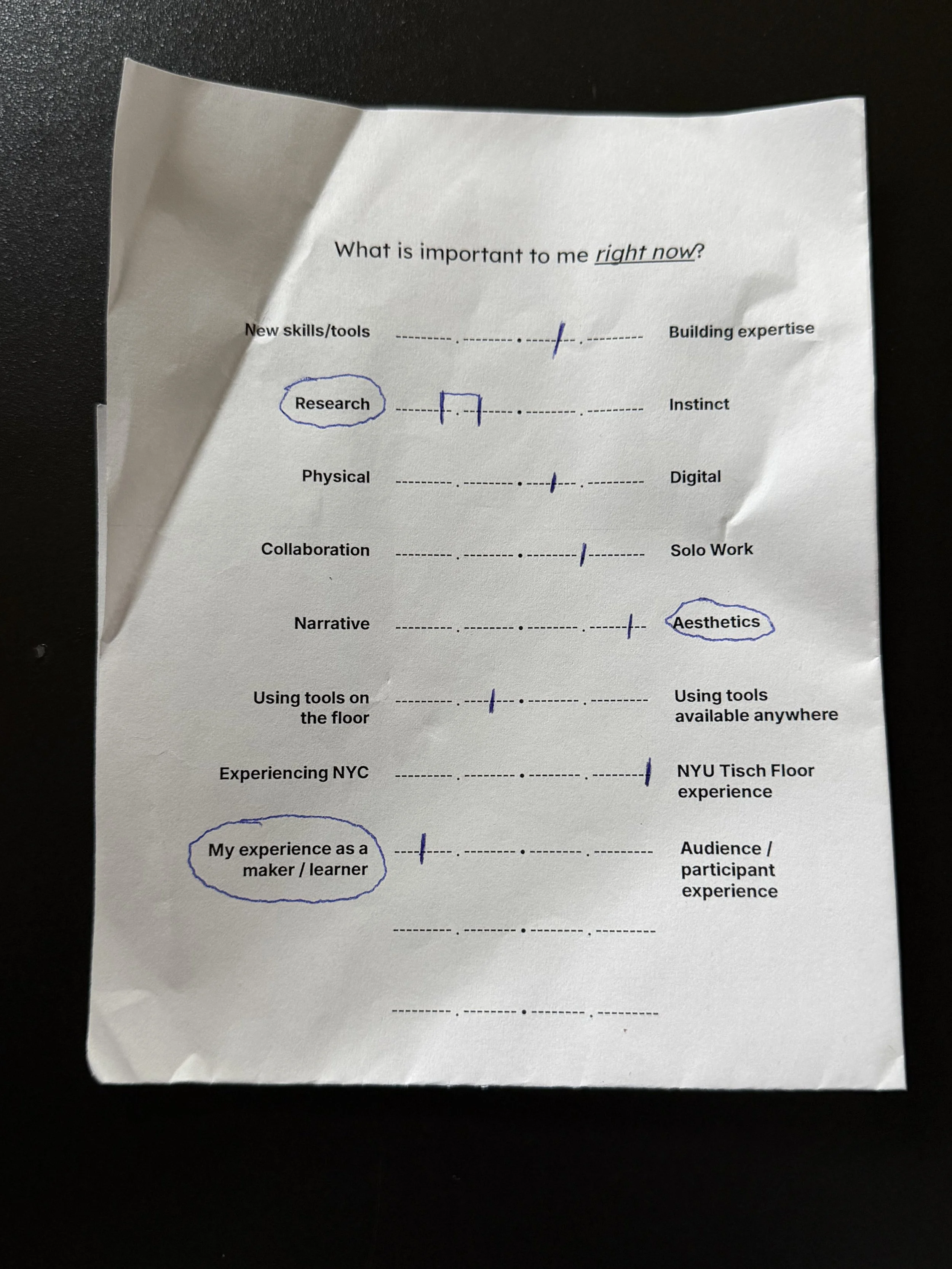
This reflection made me lean towards exploring spatial audio, as it’s a discipline that certainly requires a lot of research. I also felt like I could include strong aesthetic influence through my sound craft.
For Exploration 04, my creative plan was to create an experience in the Audio Lab where a user’s body would be tracked as they moved around the room, triggering the speakers nearest to them to play recordings of whispers. I planned to execute this with a Kinect Azure camera triggering levels in my Ableton project. I am confident in my ability to execute the idea, but I wasn’t able to get enough time in the Audio Lab to try everything.
I ended up spending about an hour setting up my computer to work with the Audio Lab’s drivers, and then I only had one hour left to actually experiment, so I decided to just practice routing audio to speakers from Ableton before linking it to TouchDesigner or the Kinect camera.
So, the result that I am getting out of Project 02 is ultimately the knowledge of how to use Ableton in the Audio Lab, and also a pretty cool sound collage:
(Note: the above audio file is the full multi-output project downmixed to stereo, so it may sound weird!)
My 30-second sound collage was made mostly from samples that I got in jianmusic’s encolour sample pack on Gumroad. I also created a few of the samples myself in Ableton. I used these sounds because of the futuristic, mechanical sounds that could not be produced by any organic lifeforms on Earth.
As I researched spatial audio concepts, I found an interesting paper by several researchers that explores the combination of the science behind spatial audio with the creative decisions that a composer might make while designing a soundscape. This graphic was particularly interesting to me:


Hong, Joo Young, Jianjun He, Bhan Lam, Rishabh Gupta, and Woon-Seng Gan. 2017. "Spatial Audio for Soundscape Design: Recording and Reproduction" Applied Sciences 7, no. 6: 627. https://doi.org/10.3390/app7060627
This diagram is described in their paper as a “schematic illustration of soundscape design process, types of acoustic environment and required techniques.” Most of it doesn’t apply to my process, since I’m not working with field recordings, but it did inspire me to consider the world that I am designing with sound.
Instead of combining random samples and programming them in random speakers, I tried to imagine a chaotic environment on an alien planet where signals, vehicles, voices, and other foreign technology blend to make a soundscape that humans would otherwise never encounter.
If I had more time, I would use a Kinect Azure camera in TouchDesigner to track a viewer’s position in the room, and then change sounds based on the viewer’s position. This is the same concept as my Exploration 04 creative brief, but instead of whispers, I’d really like to continue working with the alien soundscapes.